

Although it is generally considered to be connected with the pharmaceutical industry, the word “medical” has a much broader meaning. Because it involves sensitive matter such as human and animal health and requires special competencies, the term “life sciences” is widely used as well as the term “medical translation”.
Sub-fields of medical translation can be listed as medical documents, clinical research documents and reports, user and maintenance guides of medical devices and equipment, patent translations, medical reports, marketing authorization application files, patient information leaflets/informed consent forms, advertising and promotional texts of medical and pharmaceutical companies, publications of the pharmaceutical industry, all similar documents related to dentistry and animal health, medical literature files, and medical articles.
Characteristics of Medical Translation
- A translator who performs medical translation must have a full command of not only the target language, but also the respective field.
- The translator must have gained proficiency in medical terms and concepts.
- As it contains sensitive subject matter such as health, there is no room for ambiguity or error in such translations.
- Different types of medical texts have their own styles. Preserving these styles is crucial when transferring them to the target language.
- The translator in this domain should follow the current developments in the domain and constantly better himself/herself.
- The translator should explore the subject of the text and be well informed on the subject before it is translated into the target language.
- Upon the completion of the translation process, the editing, proofreading and final revision processes should absolutely be implemented, and other check processes should also be included in the operation. It is recommended to include revision processes such as In-Country Review (ICR), interpretation of changes and corrections to the text made by a language professional after this review, and review of the translation memories and term lists (ICRI).
- Determination and implementation of the check points, such as QA, LQA, LSO etc., which are of great use to be implemented after translations in other fields, come in useful, in addition to all these processes.
Medical Translation Types
- Medical Documents: They cover any and all reports regarding the healthcare industry. Examples of such documents include package inserts, medical articles, analyzes, clinical trials and discharge reports, medical reports, marketing authorization application files, patient information leaflets/informed consent forms, and medical literature files.
- Medical Equipment: The translation of user guides for devices and equipment used by hospitals and healthcare providers are examples of such documents. When translating these documents, it is necessary to master the product terminology.
- Medical Products: Sometimes, patients may have to use medical products temporarily or permanently. Therefore, it is very important to translate the user guides of medical products to the target language by using simple language. Translation of these documents in a way that almost everyone can understand makes patients’ lives easier.
- Texts in Psychology and Psychiatry: Texts in the psychology field should also be translated by a medical translation professional.
- Pharmacy: All reports in this field should be translated into the target language by qualified professional translators in the fields of drug information, patents, marketing authorizations and marketing authorization approvals.
If you would like to benefit from the medical translation services offered by Mirora, which has been providing professional solutions for its corporate customers’ translation, localization and language consultancy needs since it was established in August 1997, or to receive information on our medical translation prices, please contact us.
Quality assurance and process
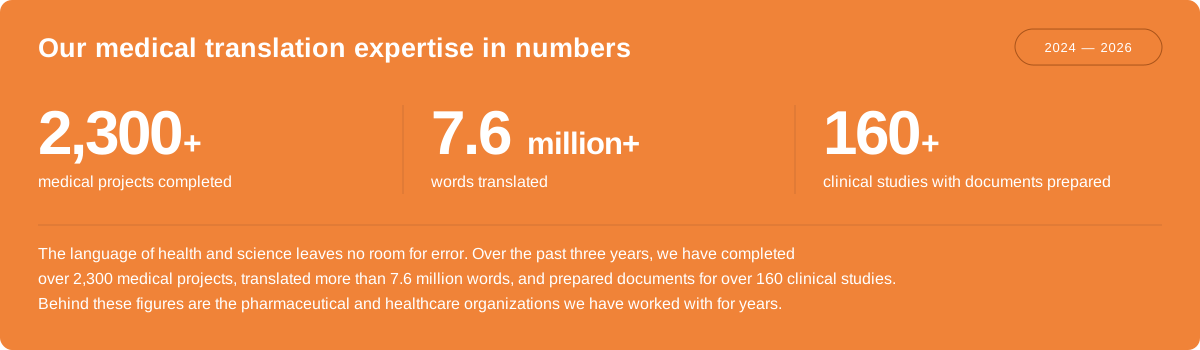
In a regulated field, an accurate translation is not enough on its own; every document has to pass through a defined quality process. At Mirora, that process has three steps. The translation is produced by a subject-matter expert translator working in CAT (computer-assisted translation) tools, which preserve terminology consistency through translation memory. The text is then edited by a separate editor, independent of the person who translated it. If the translation is not into the translator’s native language, a final proofreading is carried out by another editor who is a native speaker of the target language. Working predominantly in medical translation for over thirty years, Mirora is ISO 9001 certified, and this workflow is aligned with the translation-specific ISO 17100 standard.
Confidentiality and data security
Health data is classified as sensitive personal data under Türkiye’s Personal Data Protection Law (KVKK). Compliance with KVKK (Türkiye) and GDPR (EU), confidentiality agreements and secure file transfer are therefore essential in medical translation; documents are shared only with authorised language professionals.
Related areas of expertise
Medical translation is a broad field; each subfield has its own rules. For more details: Clinical Trial Translation, Pharmaceutical & Regulatory Translation, Medical Device Translation, Pharmacovigilance Translation, Animal Health and Veterinary Translation, Linguistic Validation Services.
Regulation and standards
Medical and clinical content is governed by authorities such as the FDA (US), the EMA (Europe) and Titck (Türkiye), and by frameworks such as ICH Good Clinical Practice (GCP). Patient-facing documents usually call for clinical expert review and, where needed, back-translation; records of translation versions and translator qualifications are kept as well. Standards such as ISO 9001 and the translation-specific ISO 17100 are seen as evidence that a provider runs its work through a defined process.
Our certifications and memberships
Mirora’s quality management system is ISO 9001 certified, and the company is a member of the European Language Industry Association (ELIA), the sector’s European umbrella body. Its translation processes run in line with the translation-specific ISO 17100 standard. These standards show that quality rests on a defined process rather than on chance.












 Türkçe
  English