

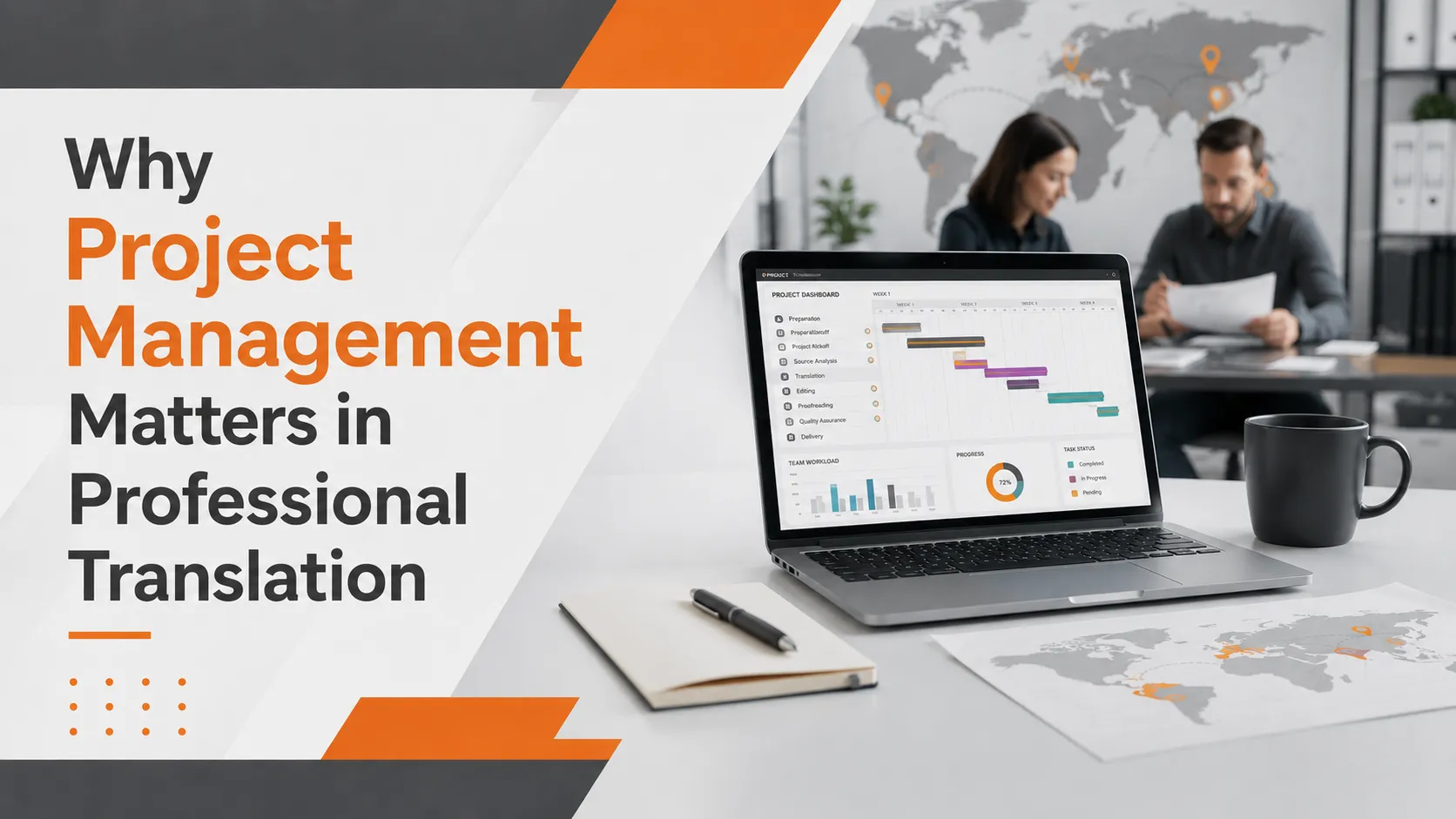
Why do some multilingual projects move on schedule whilst others end in rushed edits and missed approvals? The difference is rarely language skill alone. Professional translation depends on planning, timing, review, and clear ownership.
For international companies, translation often touches product launches, legal documents, websites, support content, and internal updates at the same time. That is why translation project management has such a direct effect on translation quality, delivery speed, and business risk. Once you look past the words themselves, the value becomes obvious.
What goes wrong when translation projects are not managed properly
When translation work lacks a clear plan, small issues spread fast. A late file, a vague instruction, or a missing glossary can affect several teams at once.
That matters even more when one source text feeds many markets and channels under tight deadlines"). . In that setting, weak coordination creates business problems, not only language problems.
Missed deadlines can delay launches and campaigns
Poor scheduling often starts with one simple mistake. Source files arrive late, design teams change layouts without warning, or reviewers get pulled in too near the deadline.
Then the delay moves downstream. A website update waits for localised copy. Paid campaigns pause because landing pages are not ready. Product teams hold back release notes because translated screenshots and labels still need checking. Meanwhile, country teams are left waiting for final files, even if all other launch work is complete.
In professional translation, timing is part of the service. If delivery dates are loose, regional teams lose the ability to plan with confidence.
Inconsistent wording weakens the company message
Without coordination, different linguists may use different terms for the same feature, claim, or legal concept. One file says "customer portal", another says "client hub", and a third keeps the English wording.
Each choice may look harmless on its own. Together, they make the brand sound less certain. Customers notice when a company names the same thing in three different ways. Sales teams notice too, because mixed language creates extra questions and slows conversations.
This is where a weak corporate translation process starts to show. If terminology is not managed from the start, the final content can feel patched together rather than polished.
Last-minute fixes increase cost and stress
A vague brief invites guesswork. Then internal reviewers rewrite parts of the translation because the audience, tone, or purpose was never clear.
At the same time, poor handovers can create version problems. Designers may place outdated text into final layouts. Reviewers may comment on an old file. The same paragraph may be translated twice because nobody tracked which source was approved. As a result, teams pay for more rounds of edits and spend more staff time untangling avoidable issues.
The extra cost is not only the supplier invoice. It also includes staff hours, delayed approvals, and the loss of focus across internal teams.
How project management improves translation quality from the start
Strong translation quality starts before anyone translates a sentence. Good management sets the brief, controls the workflow, and checks the work at the right moments.
That structure gives linguists the context they need. It also gives clients more control over the final result.
Clear briefs help translators work with confidence
A good brief answers the questions that slow work down. Who is the audience? What is the purpose of the content? What tone should the translation use? Which markets will receive it? What file format is required, and when is the final delivery due?
For many projects, the brief should also include approved terminology, reference files, screenshots, character limits, and notes on brand voice. If the text is for legal, technical, or regulated use, that should be clear from the start.
With this information in place, translators make better choices the first time. They do not need to guess whether a phrase should sound formal, sales-led, or instructional. That reduces rewrites and improves first-pass quality.
Terminology and style guides keep content consistent
Large companies rarely translate one file at a time. They manage ongoing content across products, regions, and departments. Because of that, consistency matters as much as sentence-level accuracy.
A shared glossary keeps product names, approved terms, and sensitive wording under control. A style guide helps with tone, punctuation, capitalisation, and local preferences. Translation memory can also help, especially when similar content appears across updates.
Across a long corporate translation process, these tools stop language drift. They help new files match old ones, even when different translators work on different stages of the programme. That stability protects the brand and makes review faster.
Review stages catch errors before delivery
Review works best in layers, not in a rush at the end. First, the translator checks the draft. Next, a second linguist may review for accuracy, clarity, and terminology. After that, the client or in-country reviewer can confirm business fit. Finally, a quality check can catch formatting issues, broken tags, missing text, and number errors.
Good review is a control system, not a delay.
Each stage has a clear job. Because the roles are defined, feedback is easier to sort and easier to act on. That means better translation quality without slowing the project more than necessary.
Why coordinated workflows matter in large corporate translation programmes
The stakes rise in large corporate programmes. A company may need website copy, product sheets, training material, contracts, and support content translated at the same time.
Without coordination, each team creates its own method. That leads to duplicate questions, mixed approvals, and poor visibility across markets.
One clear process reduces confusion across teams
Marketing wants fast turnaround. Legal wants traceability. Product teams want exact terminology. Local teams want content that fits their market.
A shared workflow helps all of them because it makes responsibilities clear. Everyone knows who sends source files, who answers queries, who reviews drafts, and who gives final approval. That reduces waiting time between stages and cuts the back-and-forth that often slows multilingual work.
It also helps senior teams. When status updates are centralised, managers can see what is on track, what is blocked, and what needs a decision.
Version control protects accuracy across updates
Few issues waste more time than translating the wrong file. Source content changes often, especially during launches. Pricing tables are revised. Legal notes are updated. Product screenshots change after the first draft.
If nobody tracks those changes, teams may translate old copy and then pay to correct it later. Worse still, old and new wording can end up mixed in the final release.
Strong version control prevents that. Clear file names, approval records, change logs, and one source of truth help teams work on the right material at the right time. In fast-moving projects, that discipline protects both budget and accuracy.
The right people are involved at the right time
Translation quality depends on who does the work, not only how fast it moves. Brand copy may need a marketing linguist. Technical manuals may need a subject specialist. Legal content may need a reviewer with experience in regulated text.
A managed workflow assigns those people in the right order. The translator works first, the editor reviews next, the client checks business points, and the project manager controls timing, queries, and delivery. If desktop publishing or technical file handling is needed, that can be built into the schedule instead of added at the last minute.
In a busy programme, the project manager is closer to an air traffic controller than an administrator. That oversight keeps the work moving without losing control.
The business benefits of strong translation project management
For international corporations , the value of good management shows up in business results. Better control leads to faster delivery, lower risk, and less wasted internal effort.
It also makes scaling easier. When the process works for five markets, it is far easier to extend it to twenty.
It lowers risk in regulated and sensitive content
Some content leaves little room for error. Contracts, compliance notices, safety instructions, investor material, and financial reports all need exact wording and clear approval paths.
A wrong legal term or outdated disclaimer can create real exposure. So can a missing sentence in a technical document. Translation project management reduces that risk by controlling handovers, review stages, and final checks. It also creates a record of who approved what and when.
When choosing a professional translation company, buyers should ask how the provider manages , review responsibilities, and file control.
It saves time for internal teams
Poorly managed translation turns internal staff into part-time coordinators. Marketing chases updates. Legal sorts mixed comments. Product teams answer the same terminology question more than once.
A well-run corporate translation process removes much of that burden. The project manager gathers queries, organises review, tracks status, and returns files in the agreed format. Internal teams spend less time on admin and more time on their own work.
That gain is easy to overlook, but it matters. Time saved across several departments often has more value than a small saving on the translation fee.
It supports a stronger global brand
Customers never see the workflow. They do see the result. They notice when product names stay consistent, when the tone feels natural, and when messages match across websites, contracts, help centres, and campaigns.
That consistency builds trust. It also makes the company look more organised and more credible in every market it enters. Over time, managed translation helps the brand sound like one company rather than a collection of disconnected local versions.
For firms with a global footprint, that is a serious advantage.
Projects that run late and return for endless edits usually lack structure, not effort. Professional translation works best when project management is treated as part of the service, not as an optional extra.
That structure improves translation quality, keeps the corporate translation process clear, and reduces risk across markets. For international companies working at scale, translation project management is what turns accurate, consistent, on-time delivery into a reliable standard.

 Türkçe
  English
Comments are closed